If you judged Seattle Tech Week solely by the headlines, you’d assume the whole five days were a non-stop blur of founder pitches, funding announcements, and VCs staring at slide decks.
I took a different route. I didn’t watch a single pitch.
Instead, I spent the week chasing something else—the parts of our industry that usually get buried under startup hype. I wanted to see how we protect our psychological health, use technology responsibly, and honor the human element behind the code.
The best sessions of the week weren’t delivered by hype-men shouting from a stage. They were grounded, practical, and deeply human conversations hosted by builders driving change from the inside out.
Here are the highlights from a side of Tech Week you might have missed.

1. Responsible AI in Regulated Waters: Lawyers Who Build
Legal tech is having a massive moment. But most AI software targeting legal practice is built by people who have never billed an hour or carried the weight of a client’s defense.
Monday’s Lawyers Who Build panel at SURF Incubator showed what responsible innovation actually looks like. Hosted by three women attorneys who turned into tech founders—Rachel Bender (CEO of Batesly), Jacqueline Schafer (CEO of Clearbrief), and Ashlee Drake Berry (Head of Legal at Casium)—the session bypassed the theoretical fluff to deliver an honest breakdown of AI in a heavily regulated industry.
They showed exactly how they are leveraging AI in daily workflows without sacrificing rigor or trust:
- Keep the human in the loop. The AI serves as an intelligence multiplier, not an unsupervised replacement.
- Extractive accuracy over generation. Every output must point directly back to verifiable court records or case filings. No guessing, no hallucinating.
- Automate with empathy. Keeping human impact front-and-center, especially when dealing with complex, life-altering workflows like employment immigration.
Seeing women builders show exactly how to handle high-stakes AI deployment responsibly was the best start to the week.
2. Guarding the Mind: Psychological Burnout in the Age of AI
High-velocity engineering roles have always carried a tax. But the current rapid-fire pace of building with generative AI has pushed developer fatigue to an all-time high (I wrote about this dynamic in my previous post on Jevons Paradox and developer attention).
Midweek at the Seattle Central Library, The Workplace Psychologist PLLC hosted a crucial session tackling burnout directly. Instead of treating mental health as a generic corporate afterthought, the workshop unpacked:
- Boundary hygiene. Practical strategies for protecting focus in asynchronous, always-on Slack cultures.
- De-stigmatizing the overload. Admitting that shipping at automated speeds carries a heavy cognitive tax.
- Psychological safety. Building teams where developers can raise their hands and say “I’m out of bandwidth” before the system crashes.
In an industry prone to celebrating grind culture, spending an hour focused on developer longevity was a breath of fresh air.
3. Grounding the Body: Somatic Reset & Mindfulness
It’s easy to spend all of Tech Week hunched over a laptop in windowless conference rooms. Taking time to physically reset proved to be one of the best choices I made.
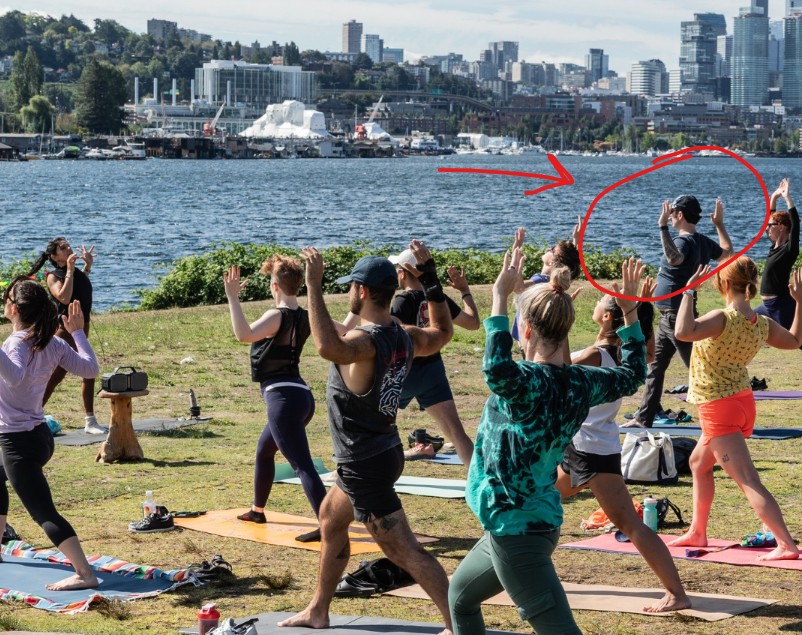
I spent two mornings on the grass at Gas Works Park overlooking Lake Union. Doing yoga with Marie Benoit of The Aloha Reset on Tuesday and Wednesday did exactly what it promised—cleared the mental clutter before the tech discussions started.
On Thursday, I went to a somatic movement workshop hosted by Whim W’Him Contemporary Dance Center and led by somatic coach Jun-Li Zhong. We spent an hour using breathwork and movement to unwind the screen tension and physical toll of desk work.
We even closed out the week with high-energy Zumba at thinkspace.
Your body is the hardware your software runs on. Take care of it.
4. Rethinking Storytelling & Mentorship
Sessions hosted by Kelly K. (Kelly Tutors), SURF Incubator, and Sound Startups stood out for challenging standard industry assumptions:
- Ditching the “Trauma Template.” A narrative design discussion examining how media, video games, and tech default to trauma as a lazy storytelling shortcut. The panel pushed creators to build narratives based on generative growth and curiosity instead.
- AI as an Internship Admin. A pragmatic look at using AI tools to manage internship programs. The core takeaway? Let the bots handle the administrative paperwork so that leaders have more dedicated time for genuine 1:1 human mentorship.
The Takeaway
Seattle’s tech community is much larger and richer than pitch decks, seed rounds, and valuation headlines.
The most meaningful conversations of Seattle Tech Week happened in the quiet corners: over coffee, during somatic breathwork, and in rooms full of builders defining how we approach AI with integrity and care.
Technology is only as good as the health and intention of the people building it.
That’s the Tech Week I was glad to attend.